
112. How printing changed everything: the Gutenberg Bible
the Gutenberg Bible first published 23 February 1455.

Welcome to Julie Lamin - Write With Me Saturday posts on writers, writing, books, poems and plays linked to dates in the year.
My Writing Challenges give you tips, ideas and inspiration for your own creative and non-fiction writing. Support my writing by upgrading to a paid subscription and receive a free copy of my novel, Beyond the Volcano.
Looking for a GCSE or A level tutor or a writing mentor? Contact: julie@julielaminauthor.com
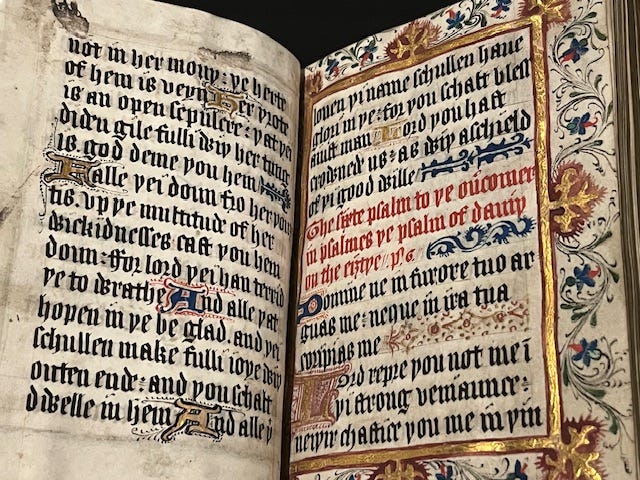
Photo by Julie Lamin. Wycliff translation into English. the British Library
112. How printing a book changed everything: the Gutenberg Bible
First published on 23 February 1455
I wrote at the end of December 2025 about my childhood understanding of the nativity story in the bible and how other children hear and interpret words rarely used in daily life.
It’s perhaps difficult for us now living in our language-intensive world with words zipping around the globe in seconds to grasp the revolutionary significance of the Christian bible being printed.
In the beginning…
“In the beginning was the Word,” reads the opening of St John’s gospel in the New Testament in English, “and the Word was with God.”
Prior to Gutenberg’s printing press, the Word was only in Latin and with the Christian Church, as only a handful of scholars could hold a pen to write the words of the bible, albeit in the most exquisite way with their gold leaf letters. Given the intricacy of their work, the written Latin Word could only be found in a few places, mainly monasteries.
The Church had control of The Word which gave them control of the people; only a priest could read the bible and interpret it.
“Look after your ploughs, your sheep and cattle in the cold and rain,” the priest might have said, “and we’ll stay indoors reading the bible so you don’t have to.”
A revolution of knowledge
Technology often gets a bad press (excuse the pun) We are nervous about the great changes it brings - as many of us might feel now that AI is threatening our lives, livelihoods and human activity - but in hindsight we are better able to see its benefits.
Gutenberg didn’t invent printing. Chinese wood block printing was well established hundreds of years before Gutenberg was born. What changed the European world was his invention of a printing press with moveable type, that is letters that can be rearranged, allowing multiple copies of identical prints. The mass printing of the bible in Latin meant that it could be read by ordinary people, (or the few ordinary people who could read Latin, who probably weren’t that ordinary), without the intervention and interpretation of the priest.
With study comes interpretations and challenges and questions about meanings and translations and even more questions about who had the right to read the bible.
A hundred years or so after the first Gutenberg bible was printed, and probably as a result of it being printed, came the next great challenge: the translation of the bible into the language of the people. What heresy! Yes, literally heresy.
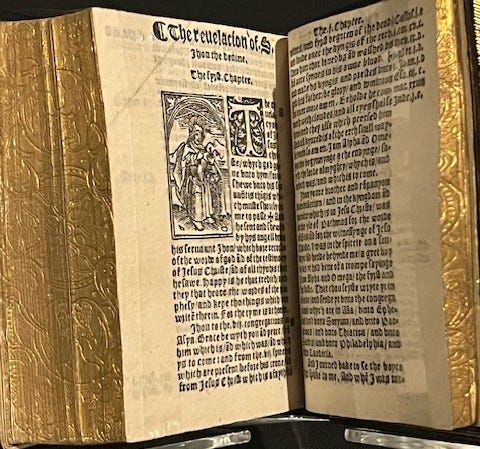
Photo by Julie Lamin of William Tyndale’s New Testament published in Antwerp in 1534. British Library.
Following the Lutheran challenge to the Pope’s authority in Rome of translating the bible into German, gifted linguist, William Tyndale, began translating the bible into the language of his own people, English, not from Latin but from the earlier versions in Hebrew and Greek. His commitment to ordinary folk being able to read the bible in English cost him his life: he was executed in 1536 by strangulation, then his body was burnt.
Accusations of heresy, imprisonment, trials and execution amounted to a fate others would experience in the wrangling over who had rights to read the bible, where and in what language. It was a dangerous time.
Hilary Mantel’s revered Wolf Hall trilogy shows the nuances of beliefs - what was advocated one week became heresy the next - and who would be burnt at the stake for believing the bible should be accessible to everyone in their own language and who would get their head chopped off for holding the opposite view.
Nice business for the printer!
Although Tyndale’s English bible had contributed to his execution under the orders of Henry VIII, two years later in 1538, the same king commanded that every church in the land - now all Protestant - should have their own English bible:
“one book of the whole bible of the largest volume in English”.
In 1539, Thomas Cromwell arranged for nine thousand big bibles, known as the Great Bible or Cromwell Bible, to be printed and installed in every church for parishioners to read. That is if parishioners could read.
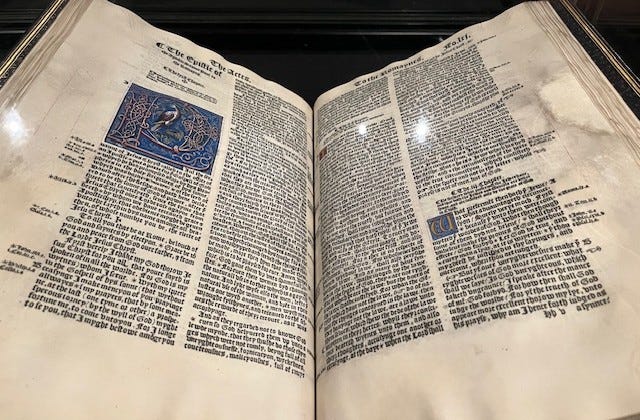
Photo by Julie Lamin. Henry VIII’s Great Bible. British Library
The cat is out of the bag
The assumption of literacy led to the spread of literacy, aided and abetted by printing. People had access to lots of words beyond the bible - poetry, essays, songs, written music - and a century of learning became the Renaissance, and it was only another century on that people began reading for pleasure… and then the novel was born, but that’s for another day.
How far we have come!
Without the Gutenberg bible being printed we would not be here now, me writing this, publishing it on my own Substack platform and you reading it.
Reading and Writing Challenge
Make a list of all the printed material including books that enhances your life.
Thank Gutenberg!
Next week is World Book Day.