
116. What a saint!
Saint Oscar Romero - killed on 24 March 1980

Welcome to Julie Lamin - Write With Me Saturday posts on writers, writing, books, poems and plays linked to dates in the year.
My Writing Challenges give you tips, ideas and inspiration for your own creative and non-fiction writing. Support my writing by upgrading to a paid subscription and receive a free copy of my novel, Beyond the Volcano.
Looking for a GCSE or A level tutor or a writing mentor? Contact: julie@julielaminauthor.com
Saint Oscar Romero
murdered on 24 March 1980

“No-one should comply with an immoral law.” Mural featuring a painting of Oscar Romero Photo by alexandre alex on Unsplash
“What a saint!” It’s a great compliment when someone does something exceptionally kind, but real saints? Aren’t they people who have been dead for centuries?
I used to think that, until 2018, when Pope Francis made a saint of someone who was alive in my lifetime and who inspired and changed the course of my life. That person is Saint Oscar Romero.
As Archbishop of San Salvador, in the Central American country of El Salvador, he dared to speak out against injustice. He was murdered on Monday 24 March 1980 while celebrating Mass.
So how did someone living in a country thousands of miles away, have an impact on me?
In 1979, as part of my university degree, I spent a year living and studying in Mexico. I learnt that as Latin American countries gained their independence from four-hundred years of Spanish rule, the United States took control of the region’s economies and politics largely by imposing dictatorships which terrorised people and kept them in poverty.
In El Salvador in the nineteen-seventies…
… if you asked for food, better conditions, took part in demonstrations, you’d be branded a ‘communist’ and the United States-backed National Guard and Death Squads might kill you, or torture you, then kill you. They might ‘disappear’ you, so your relatives never have a body to bury, or dump your mutilated body for someone to find. If the Death Squads believed a village was hiding ‘communists’, they would shoot everyone and torch their houses.
I know this because after I returned to the UK from Mexico, I volunteered to be an interpreter for El Salvadoreans visiting the UK to speak about what was happening in their country. As an interpreter from Spanish to English, I had to speak as if I had lived it. Salvadoreans’ stories became mine; I could not unsay what I had been told. Here is one of the saddest:
In El Salvador, because people were afraid their village would be burnt and they would be killed, they escaped to hide in the mountains. The National Guard soldiers were hunting them down. The villagers hid silently in the rain forests. One of their children began to cry. Afraid the cry might expose their hiding place, the father covered his child’s mouth. The child became silent. When the father moved his hand, his child was dead. He had suffocated his own child to protect the village.
Nuns and priests, living according to their Christian beliefs with the poorest communities, were murdered. Oscar Romero, as Archbishop of San Salvador, spoke out against the atrocities, begging the National Guard soldiers to stop the killings. A month before his death, he appealed to then US president, Jimmy Carter, to cease funding and supplying arms to the National Guard as the weapons were being used against the civilian population. In what would become his last homily on Sunday 23 March, 1980, in San Salvador Cathedral, he urged:
"Brothers, you come from our own people. You are killing your own brothers and sisters. Any order to kill must be less than God’s commandment, 'Thou shalt not kill.' I beg you. I beseech you. I command you in the name of God, stop the repression.” 
San Salvador Metropolitan Cathedral. Photo by Jaime Alegría on Unsplash
The next day, celebrating Mass, Archbishop Oscar Romero was shot through the heart. He became the martyred hero of millions of Latin Americans for his stand against injustice and repression.
So why is Saint Oscar Romero important to me?
His courage to speak out in defence of Salvadoreans taught me to care about others and speak out against injustice. His courage and that of the nuns and priests who were also murdered, showed me that faith is about action as well as prayer. Theirs was the ‘greater love’ at the heart of Christianity, ‘there is no greater love than dying for a friend.’ Their example gave meaning to the religion I had grown up with.
In September 2017 when I started writing Beyond the Volcano, a story in which five brave teenagers risk their lives to fight against cruel injustice and create a better world for the future, one of the teenagers called himself Oscar.
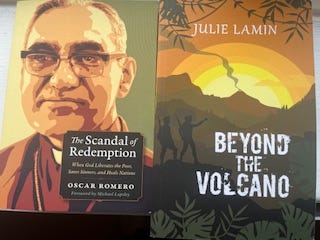
In my novel, young people from poor families are murdered because they want a better life and education, as happened in EL Salvador, Nicaragua, Guatemala and other Latin American countries in the 1970s. My character, Bishop Francis, also speaks from the pulpit against injustice. I use different words, but try to echo Oscar Romero’s impassioned pleas:
    "Young people are not our enemies but our future. Let there be no more killing of our youth! No more deaths in our schools or on our streets! Let there be no more killings of our brothers and sisters in the countryside!
I say this to you so that I may be heard by those who give the orders for the murder of innocents, and those who carry out their orders."
Like Saint Oscar, my fictional Bishop Francis is murdered by the death squads, yet not silenced, as people learn from his courage to stand up against injustice.
‘Together we are strong’ is their motto.
In October 2018, as I was doing final edits of Beyond the Volcano, I heard the news that Oscar Romero was officially elevated to being a saint.
Easter approaches. Saint Oscar’s courage and commitment prefaces Easter with the message that loving our ‘brothers and sisters’ whoever they are is more powerful than death.
In memory of Saint Oscar Romero, and the seventy thousand El Salvadoreans who were murdered for being poor, asking for a better life or for speaking out against injustice.
Writing Challenge
Who has inspired you or brought a new perspective to your life?
It’s really difficult condensing a life into a few paragraphs as I have tried to do here. I have found creating the sub-headings helped me. Write about someone who has inspired you and use these or your own sub-headings to help you.
I’m always looking for guest writers! Please get in touch if you have an idea for a Substack post.
Next week: 2026 - Happy Year of Reading - the books that made me a reader.