
97. Write From the Heart
Louisa May Alcott's Little Women

Welcome to Julie Lamin - Write With Me Saturday posts on writers, writing, books, poems and plays linked to dates in the year.
My Writing Challenges give you tips, ideas and inspiration for your own creative and non-fiction writing. Support my writing by upgrading to a paid subscription and receive a free writing tutorial and copy of my book, ‘Beyond the Volcano’.
Looking for a GCSE or A level tutor or a writing mentor? Contact: julie@julielaminauthor.com
97. Write From the Heart
“On 13 November 1913 suffragette leader Emmeline Pankhurst delivered her famous ‘Freedom or Death’ speech in Hartford, Connecticut, in the United States of America. She had not long been released from prison and was defending the militant actions of the Women’s Social and Political Union, the WSPU. She compared the American struggle for independence from England, the American Revolution, to the suffragette’s struggle with the English government for women’s rights to vote.”
This is as far as I got because the time I had allocated myself to write about her – Wednesday afternoon – I decided to make an impromptu visit to the theatre to see a dramatisation of Louisa May Alcott’s wonderful novel, Little Women. I think Emmeline Pankhurst would approve of me making this this change to write about a revolutionary American novel that makes women the main characters and heroes in their everyday actions, as well as challenging the roles expected of women to stay at home, stay quiet and get married.
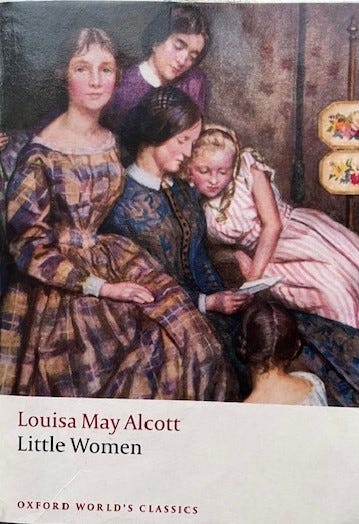
Little Women
Back in September, (Write With Me post 90, Why I Love the Theatre - see link below) I wrote about how an impromptu visit to the theatre in my teens initiated my love of theatre and put me on the righteous path of taking school seriously. In turn this took me to university to study English Literature, perform in Spanish plays and to my happy life as a teacher of English… and taking teenage students to the theatre.
Last Tuesday night, when I received an email from the Liverpool Playhouse saying tickets were available for the Little Women matinee next day, I felt a sudden determination that I should go. With a similar guilt to that of neglecting a relative or friend, I very much owed the theatre a visit. So at 1.20pm on Wednesday afternoon, I was sitting beneath the vaulted ceilings of our Victorian theatre with its high proscenium arch stage, set like a 3D painting of a winter woodland and a cosy nineteenth-century parlour.
When the play began with the most beautiful singing of “Glory, Glory Hallelujah”, Julia Ward Howe’s Battle Hymn of the Republic, written in 1861, we were plunged back in time to the American Civil War (1861 -1865), not to the battle front, but the home front and the women of the March family.
What are the books that changed your life?
What are the books that changed your life? I had been reading Facebook answers to this question on the train journey to the theatre. I couldn’t think of my own, but within a few minutes of the play starting, I knew that Little Women was one of the books that changed me, partly because it was one of the first books I progressed to as a reader when I no longer needed pictures. I felt that I was fearlessly venturing into the pages of dark dense print, with the confidence and excitement of the story to come and that my reading courage would be rewarded. It was.
Little Women reflected family life of fierce jealousies and rivalries and how we learn to get on together. It was a redemptive read – we could see how terrible mistakes were made, but also how they could be overcome and forgiven.
For a child of eight, Little Women gave me an insight into being an older girl and the expectations and life choices women could make. Not a huge amount of progress had been made for women between the eighteen-sixties and nineteen-seventies, although thanks to Emmeline Pankhurst and the suffragettes, women had got the vote.
Perhaps one of the aspects I love most about Little Women is how fully formed yet different the sisters are and how we identify with them. Independent ‘boyish’ Jo was always a fantastic role model for me, rejecting the ‘female’ path laid out for women (then as now) and being true to her own values. I’d like to think that Jo was an early feminist. Perhaps she even inspired Emmeline Pankhurst! I will commit to finding out.
Write From the Heart
Meeting Jo again all these decades later on the Liverpool Playhouse stage, I now fully admire her determination to put her love and talent for writing first, thanks to the encouragement of her mother and sisters, and possibly her absent father, a chaplain supporting the Union forces in the American Civil War against the rebel states whose wealth was founded on the blood of slavery.
If my focus as a child reader was on the girls, the ‘little women’ my focus in the play was on the emotional journey of the ‘single mother’, trying to stay strong, be fair to each of her four daughters and have a special relationship with each of them.
What I loved about Anne-Marie Casey’s adaptation at Liverpool Playhouse was its homage to the author, Louisa May Alcott, and how Jo is modelled on Alcott’s life as a young female writer successfully making money from selling her stories. When she is given the advice to: “write from the heart; write the book that is true to your life”, it leads to, we assume, the writing of a book for all time, a classic, Little Women. Writing from the heart shows that families are full of love but with times of anger and frustration and that in the journey to be good human beings we cannot always meet the high standards expected. We are allowed to fail and grow. Jo shows us that first we should be true to ourselves – live our lives ‘from the heart’ and then we can be true to others.
Her soul goes marching on.
As my decision to go to the theatre came too late to ask anyone to go with me, I went alone, but you are never alone in a theatre. Although I didn’t pay for a seat for her, my mum was there too, in spirit. I would not have been there but for her. I thought of the many times we had sat in the Liverpool Playhouse theatre together over the decades, particularly in the last decade of her life. I mentioned in my Why I Love the Theatre post how, as I began to reduce my teaching hours, I first asked to have Thursday afternoons off so I could go to the matinee performances with mum.
In the aloneness of the theatre, I celebrated that mum and I made those special theatre dates, of being two little women doing our best in our little lives to be true to ourselves and enjoying each other’s company.
Her soul goes marching on.
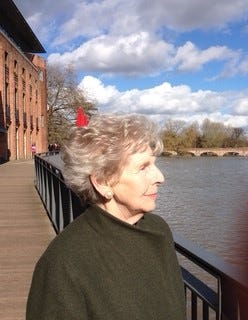
Photo: Jean Lamin. Royal Shakespeare Theatre, Stratford-upon-Avon 2018
Writing Challenge
1. Think of something you shared with a special person, a parent or grandparent, perhaps. Write from the heart about what was good about doing those things together.
2. Write about a book, film or play that has influenced your life.
See Substack post 90, Why I Love the Theatre
One ordinary Monday evening after tea in 1972, mum was reading the Yorkshire Evening Post: ‘Two-for-one theatre tickets at the Grand Theatre, Leeds on Monday night,” she read aloud and asked me if I’d like to go.
Like to go? The theatre? At fourteen I had only been to pantomimes and a grown-up play sounded exciting.
“Can you look after the children while Julie and I go to the theatre?” Mum asked dad.
It was a rhetorical question. We put on our coats, caught the number ten bus and were in the Leeds Grand Theatre in time for the curtain to rise on Noel Coward’s play….